Figure 2. The Hieron building at the sanctuary of the Great Gods. Samothrace, Greece. Artwork by Marsyas assumed (based on copyright claims). Creative Commons license.
There is an ongoing debate about the historical
context of the dedication. The questions turn around to who dedicated the statue,
for which victory, and why the dedication was made to the Great Gods of
Samothrace under Macedonian rule rather than to some geopolitically neutral,
e.g., the panhellenic sanctuary of Delos. Researchers have always
agreed that the statue represents the goddess Nike, despite the absence of
inscriptional evidence, presumably because Nike is the only goddess ever
represented as a winged woman. All the winged female figures have always
represented the goddess, Nike. But could Nike (νίκη; nikē) have initially meant
something else, and victory only be a metaphorical use of the term in the
context of a battle? Could Samothrace have gained its name after what was
happening there? After all, the immigration of Samians and Thracians on the
island is only hypothetical.
The etymology of νίκη (nikē; victory) is
uncertain. Beekes suggests a Pre-Greek origin (Beekes 2010).
Others consider it as a cognate with Ancient Greek νεῖκος (neikos),
quarrel, strife, feud, railing, abuse, strife at law, a dispute before a judge,
challenge to authority, battle, fight, hostilities between whole nations, and
Lithuanian ap-ni̇̀kti, to attack, all deriving from a
Proto-Indo-European *neik-, meaning to attack, start vehemently,
start-up, set in motion (Blümel 1982). The Byzantine term νίκεα (nikea)
is synonymous with φιλονεικία (philoneikia), meaning quarrel,
hatred; but we also find νίκλον (niklon; also written
as liknon), the cradle, and νίκορ (nikor),
corruption (wear, wear and tear, decay, attrition, spoilage, deterioration,
distortion) in the same lexicon (Hesychius and Schmidt 1867). The Ancient
Greek verb νικάω (nikaō), or Ionic νικέω (nikeō), is used to conquer, prevail in battle, in the games, or in any contest, be
superior, or overpower.
The Ancient Egyptian nik meant evildoer (who somehow harms), nkn, harm, injury, sword, and nk, to copulate (Dickson 2006). The latter root relates to Akkadian nâku (or niāku),
to have illicit sexual intercourse, to fornicate, and to Tahaggart[5] enki, to do sexual act
movements, from Proto-Afro-Asiatic *nukʷ-[6], to have sexual intercourse. Via the Algerian form
نيك (nīk; nick pussy, screw, lovemaking), the
Egyptian nk is thought to have reached Maltese as niek (/nɪːk/),
to fuck, screw, and French as niquer, to fuck, bang,
beat, hit, break, destroy, caress (repeated palindrome movement), or in the
sense of fourrer, to put into something, shove, cram, ram. Among
the cognates of nk, we may also consider Late Middle
English nik, meaning a notch, tally, nock of an arrow, a
notch in a bow to hold the bowstring, notch at the rear of an arrow that fits
the bowstring, cleft in the buttock, probably related to Old French niche,
recess, niche, a shallow recess in a wall, Czech nika, niche,
or Modern English nick, meaning a notch, groove, slit, a
small cut in a surface, the exact point or critical moment, or the verb
to nick, to cut or scratch in a minor way, make ragged or
uneven, deface, mar, fit into or suit, as by a correspondence of nicks,
tally with, strike at the precise point of time, to hit upon, make a cut. In the same semantic space, we find knock, knock-in, knockout, knockdown,
Middle Low German nicken, to bend over, to sink,
Middle High German nicken, to bend, depress, Modern
German nicken, to nod, Middle Low German knicken,
to bend, snap, or Modern German knicken, to bend, break, as
well as Old English Nicor (Nixie; /ˈnɪksi/)
and its Germanic cognates (German Nixe; Dutch nikker, nekker;
Danish nøkke; Norwegian Bokmål nøkk;
Nynorsk nykk; Swedish näck;
Faroese nykur; Finnish näkki;
Estonian näkk) signifying shapeshifting water spirits
in North European mythologies and folklore.
The latter group of mythological terms probably
refer to splashes and waves produced by the impact on still water surfaces or the
perpetual transformation of water shapes. Water impacts practically everything.
It can take infinite forms when running or hit. But it may also
corrode metals and minerals, erode soil and stone, deform the shapes of things
swimming in it, swallow humans and ships, become solid or vapour,
or transform into growing living beings. The potential relationship
between Proto-Germanic *nikwiz or PIE *neigw-,
supposedly giving rise to all European nik-words, with the
Egyptian nk, Greek nikē, of
Proto-Afroasiatic *nukʷ-, raises an alert. The
derivation of a hypothetical root depends on the languages and the words we
include for reconstruction. In general, by ignoring attested Ancient Egyptian
or Afroasiatic terms, one is bound to conclude a PIE origin. I am afraid that ideology
sometimes drives etymology (Arvidsson 2006; Mallory 2021).
The notion of damage caused by the impact of a
forcefully moving object against a still surface is evident in all the
above nik-like words. Violent motion and sudden stillness are
precisely the sememes conveyed by the posture of the Nike of Samothrace. The
vulgar sexual connotations probably derive from the notion of damage to the
hymen during first penetrative intercourse or simply from the nik-like
(notch-like) form of the vulva. This vulgar misconception of nikē (impact)
may be the origin of the belief that the Mysteries generally included phallic
worship (see citation of the Catholic Encyclopedia above). In
Greek, νικητής (nikētēs; winner in games, conqueror) is
essentially one who causes attrition to an opponent, while νικημένος (nikēmenos;
Modern Greek for defeated) is the one who suffers attrition. Thus, the primary
meaning of nikē is the damage caused by the
impact of violently moving objects (e.g., the fists of a boxer) hitting the exact
point at a critical time. The ‘goddess’ Nike (victory) is
invariably represented by holding a stick (for nik-ing) and a wreath
of bay laurel leaves, symbolising victory, conquer, and higher status.
According to the Roman naturalist Pliny the Elder (23/24 – 79 AD), laurel
oil-treated bruises and muscle conditions. Therefore, laurel’s leaves would be
an ideal present for the fight’s winner.
Whereas the stem nik denotes
damage from an impact on a still object, the result of a hostile movement
against stillness, the reverse stem, kin, denotes the movement
itself with positive connotations. The most iconic Ancient Greek word is
κίνησις (kinēsis). It means motion, emotion, dance,
movement, change, revolution, revolt, removal, and change of abode. It derives from
κινέω (kineō), to set in motion, move, remove a thing from
its place, change, innovate, incite or stir up, call in question an assumption,
set going, cause, call forth. Also, κινύσσομαι (kinyssomai)
means to waver, sway backwards and forward; κινέομαι (kineomai),
to move on, march; κίνυγμα (kinygma), anything moved
about; κίνδυνος (kindynos), danger, hazard, venture, risk,
trial (notions standing before and against a negative impact; prevention
of nik); κινάθισμα (kinathisma),
motion, rustling, as of wings. The Ancient Greek κίνητρον (kinētron),
ladle or stick for stirring, drifted to mean motivation, motive,
incentive, and stimulus in Modern Greek.
Interestingly, κίναμον (kinamon)
or κιννάμωμον (kinnamōnon) has been glossed and translated
as a superior kind of cassia, cinnamon (Cinnamomum cassia),
i.e., a spice producing tree that grows in China and Southeast Asia. I do not
believe that Herodotus, who mentions cassia[7] and kinnamōnon (or kinamōnon),
knew of cinnamon. The cinnamon tree belongs to the same botanical family as the
bay laurel (Laurus nobilis), Lauraceae. In Chinese, bay
laurel, cinnamon, and osmanthus of the olive family had the same name[8].
Olive and laurel branches were used interchangeably to symbolise victory and
peace after strife. They are both associated with skin protection and healing.
Since oils protect wrestlers from bruising and machines from friction, an olive wreath was
the prize for the winner at the ancient Olympic Games. The smoothness,
protection, and friendliness of kin- as opposed to rivalry,
aggression, and hostility of nik- are also implicit in the meaning
of English kin, kind, king, skin, napkin, and bikini.
A diminutive, the Middle English suffix -kin (gherkin, pumpkin, etc.) denotes a lesser, therefore, less ‘threatening’ and kinder kind
of object. More impressive antonymy by inversion is that between the
French niquer (NIQER; NIKwER; to shove, stick,
stuff, fuck, implying destruction by pushing and involuntary stuffing) and its inverse requin (REQIN; REKwIN; shark), a
fish that notoriously swallows everything on its way (destruction by sucking
and voluntary stuffing). In this case, qu is a digraph (Qu)
that remains as such after inversion.
Undoubtedly, something important was happening on the
island of Samothrace, specifically in the sanctuary of the great gods.
World-class art is not created or placed in the middle of nowhere. Masses of
pottery and other findings on the site date from the first half of the 7th century
BC, suggesting that such activities may have begun as early as 700 BC. All the
inscriptions found are in a perfectly recognisable Greek alphabet. However, the
fragmented words are not recognised as Greek and are therefore classified as
Pre-Greek even though some date as late as the 4th century BC (Figure 6 in Graham 2002).
The explanation is that these inscriptions are religious texts that have
preserved the archaic language, like modern Christian liturgies have preserved
Latin or Hellenistic Greek (Lehmann 1955). If the inscriptions are
not recognised as Greek, their words will never enter any Greek dictionary. As
long as these words are not in any Greek dictionary, they will never be
recognised as Greek. But how can Greek be defined, if not as anything written
with Greek letters, unless otherwise identified?
If the site were a religious institution receiving
offerings from everywhere, we should expect more diverse votives comparable to
Nike to be found. This is yet to be the case. The alternative hypothesis put
forward here is that the campus of the ‘great gods’ (great professions) was a
school of civil engineering, perhaps a polytechnic, comparable to French Grandes
Ecoles. This would explain why the mysteries (instruction) proceeded in two
phases (Lehmann 1955): the initiation (introduction, theory) and the
epopteia (supervision, practical works, workshops). In fact, the words mystery
and instruction are literal translations of each other as they have the same morphology
and semiology. The morpheme my- is equivalent to in- (into,
in; from PIE root *en, in; see section MU)
while -struction derives from PIE *stere-, to
spread (Greek -stēr-, to order, structure; see section Rite and worship) through *streu-, Latin struere,
to pile, build, in-struere, to arrange, prepare, set in
order, instructio, an array, arrangement, in Late Latin,
teaching, Old French instruccion (14th century)
and Modern French instruction[9].
Note the correspondence between PIE *stere- and Greek
-στήρ-ιον (stēr-ion) from μυ-στήρ-ιον (my-stēr-ion; English my-ster-y).
Similarly, initiation, noun use of
Latin neuter past participle of inire, from in-, into,
in (from PIE root *en, in) + Latin ire, to go (from PIE
root *ei-; to go)[10] is
semantically identical to introduction, from intro-,
inward, to the inside, + Latin ducere, to lead (from PIE *deuk-,
to lead)[11].
The initial term literally means to go inside from the initiate’s (student’s)
perspective; the other is to lead inside from the initiator’s (teacher’s)
perspective. The word ἐποπτεία (epopteia) is glossed as the highest
grade of initiation at the mysteries and is left untranslated in the relevant
texts. Yet, in Modern Greek, epopteia (εποπτεία) means
supervision or proctorship. In contrast, the closest Ancient Greek verb, ἐποπτεύω
(epopteyō), means to overlook, watch, of an overseer, and
ἐπόπτης (epoptēs) means overseer, watcher, supervisor,
examiner. By simply using untranslated terms such as mystery, initiation, epopteia, and sanctuary (from Latin sancire, to consecrate) instead of their exact Modern English equivalents, teaching, introductory
lectures, hands-on workshops, and school, scholars
can turn a technical education campus dedicated to professional training –
theory and practice of arts and technologies – into a mystical theological orgy
place.
An extraordinary piece of art in a cult place
may represent a celebrated deity or a votive offering from a distinguished
person for a prominent event. A statue like Nike placed in a school courtyard showcases the skills to be learned: here we teach sculpture, military
shipbuilding, naval arts, ramming, nicking, powerful movement, pistons, gravity
forces and equilibrium, whatever. A cult object is imaginary and can bear any
features we can imagine or cannot. We might imagine, for example, that our
victory against our fiercest enemy would not be possible without the help of a
delicate young lady (or the mere will of the Virgin Mary) who flew down from
the sky to push our ships. However, the showcase of a school must evoke real
things to make it attractive. We have all seen birds flying. They can win gravity and elevate themselves from the ground into the air by moving their wings up and down. Even a delicate young lady could lift
a boat made of massive rock if she had wings.
We do not need semiotic analysis to visually
combine the dainty-winged female creature dressed in fine drapery with the
weight of a massive rock the size of a battleship. The image immediately
evokes lifting machines and techniques. Monotheists automatically associate
winged human figures with angels, literally meaning messengers in Greek. A
messenger is an intermediate between an emitter and a receiver, the means or
medium by which the emitter (thinker) instructs (orders, commands) the receiver
(doer). But the average ancient consumer was probably unaware of the existence
of winged angels in heaven. Their immediate preoccupations were in
life-threatening situations like drawing that water out from their bloody
sinking boat or lifting the last goddamn stone to the top of the wall without
it falling on their toes.
The Greek ἄγγελος (aggelos; pronounced /angelos/; angel,
messenger, envoy) derives from the verb ἄγω (agō). The
latter means to lead, carry, fetch, bring, take with one, carry off, carry
away, carry as cargo, import, draw on, bring on, bear up, carry far and wide,
spread abroad, lead towards a point, lead on, guide, manage, refer, attribute,
bring up, train, educate, reduce, draw out in length, a drawdown in the scale,
hence, weigh. In aggelos, the G of agō doubles
(archaic >>) probably indicates a long distance between the emitter and
the receiver, so long as to require an intermediate step, the messenger. In
contrast, the cognate ἀγέλη (agelē; herd) implies close
distance between individuals that are led as an ensemble from one point to
another (|-|; H; final ē). In another cognate of agō,
ἀγωγός (agōgos; leading, guiding, drawing, drawing forth,
attracting, conduit, duct, conductor, pipe, channel, canal), the distance is
still indicated by duplication of G, but the G’s are separated to evoke a
modular structure (> OO>; >Ω>).
Before considering spiritual metaphors for the
iconic symbols of the monument, let us derive a more literal significance. The
interest of being a bird is that you can take the shortest path, the straight
line between origin and destination. The angelic figure brings something
because she is a bringer (messenger, angel) by literal definition. Since she
stands on a ship, she most probably leads, drives, carries or fetches the ship
to its target. She leads the ship against her enemy if we are accustomed to
thinking of history as a mere series of battles. The presence of a naval ram
(assuming this feature once existed) points to a military interpretation.
Alternatively, the ram is only to indicate the ship’s large size. The lady
simply fetches the ship from her construction site to the sea. Since she has
wings, she can easily do it by air, without friction, following a straight
path. I vote for the latter interpretation. Only exceptionally were women
involved in modern naval battles, more like sponsors than soldiers, but never
in early Greek history. Why would a proud ship commander lend his victory
to a woman anyway?
Another famous winged creature in Greek mythology
is Pegasus. That one represents a valve (see section The slaying of Chimera by Bellerophon with Pegasus). Valves
move up and down like wings and confer tremendous powers to water or air tools.
Ancient Greeks must have been familiar with the symbolic value of the wing
since they used it recurrently. If the wings of Nike evoked valves and the word
for a ship ram (embolon) was the same as for the piston, then the
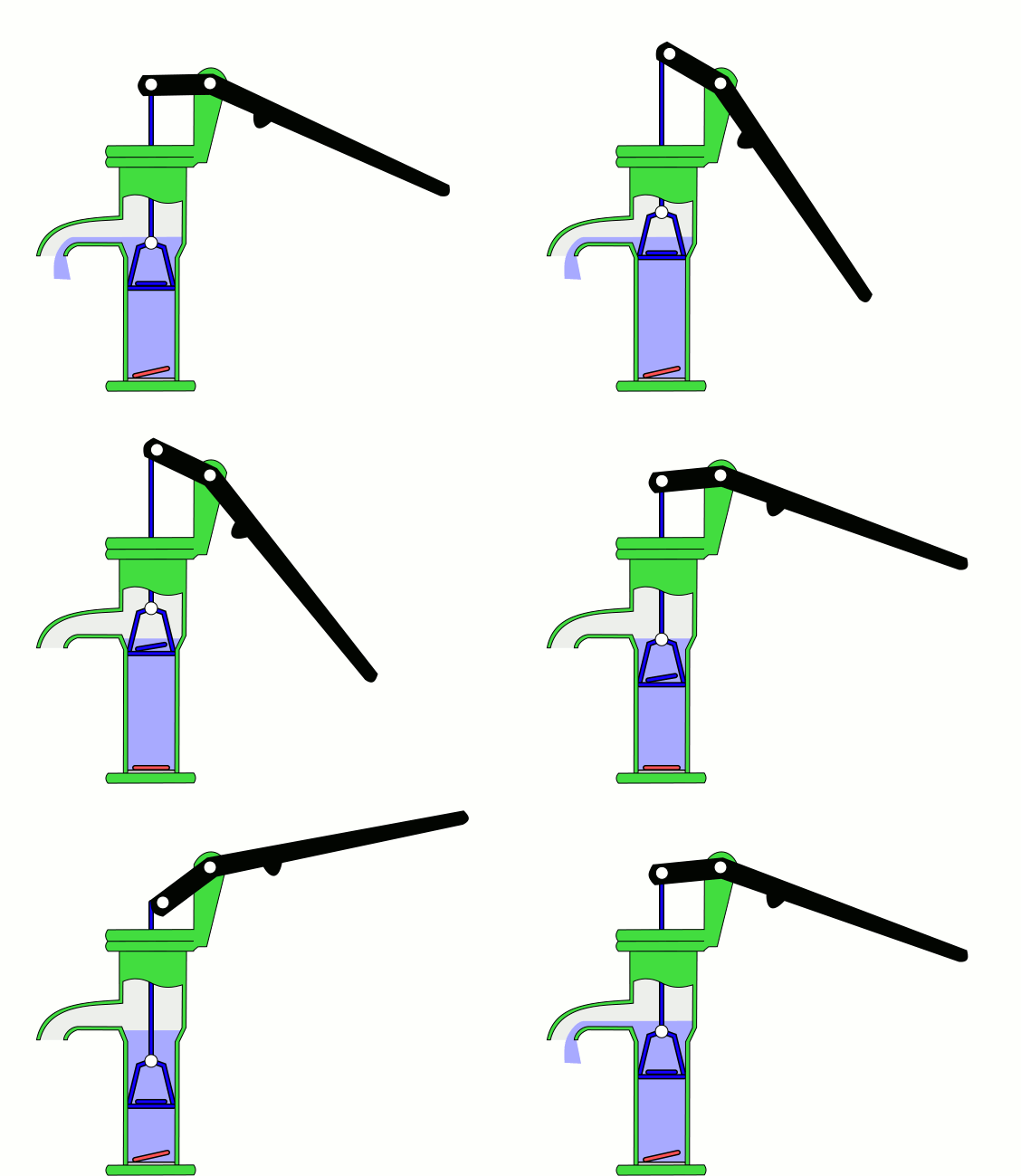
monument could be an artistic interpretation of a pump.

Figure 4. Animation of a suction hand water pump. On the
upstroke of the piston, the foot valve opens, and suction brings water into the
pump head. The valve opens on the piston’s following downstroke, and the water flows upwards. On the next upstroke of the piston, water is pushed out
of the outlet. Artwork by Manco Capac and Michael Frey. Creative Commons license.
The first textual descriptions of a well-pole (also
known as counterpoise lift, well sweep, shaduf, or shadoof; Fig. 3)
in Akkadian cuneiform from Mesopotamia date from around 2400 BC. Its first
depictions appeared a couple of centuries later (Bagg 2012; Yannopoulos et al. 2015). A shaduf is an early crane-like tool with a lever mechanism for
irrigation. It is not a water pump, properly speaking. Still, it does contain part
of the idea of a hand-operated water pump (Fig. 4).
The Greek verb ἀντλέω (antleō), to pump, is already used by Herodotus
(circa 484 – circa 425 BC) in a passage[12] describing
how the Persians draw oil (petroleum) and asphalt from a well, unfortunately
not in sufficient detail. Antleō generally means to draw water from a well, bale out bilge water (ἄντλος; antlos), and bale the ship. Among a few other cognates of the stem antl,
all about drawing water, we find ἀντλητός (antlētos), meaning irrigated, and ἀντλία (antlia), meaning hold of a
ship in Ancient Greek, reservoir by the 1st century BC (papyrus
BGU1120.26), or pump nowadays. The common sememe among the hold of a ship,
irrigation, and a reservoir is pumping. One of my reasons to believe that antl does
not refer to simple water drawing with a bucket but to a full-blown pump
mechanism is that a bucket would not be sufficient for large, deep ships. The
other reason is that antl results by inserting an N for
movement (see section N), into the stem atl, as in Atlas, an irrigation network, as I explain in the chapter about Atlantis.
According to the Online Etymology Dictionary (OED)[13],
the early 15th-century pumpe and Modern English pump are
probably from Middle Dutch pompe, meaning water conduit, pipe, or from Middle Low German pumpe (pump; Modern German Pumpe),
both from some North Sea sailors’ word, possibly mimicking the sound of the
plunger in the water. The earliest English uses refer to a device for raising
and expelling bilge water from ships. The Late Old French pompe probably
comes from Germanic. Pumps are ancient, and the Germanic word’s late appearance is odd.
Based on linguistic evidence presented later, um is
the equivalent of Greek ym and the inverse of mu (my; see sections MU, MY, and YM, and UM). The inversion of a letter sequence creates antonymy. If MY is the interior of an object, YM
is the exterior. MY or MU may be used for the notions of in, into, internal,
inserting, etc., and YM or UM for the opposite notions: out, outward, outside,
external, extraction, surface, etc. The two P’s of pump stand
for two mouths, holes, orifices, the archaic smiley sign ) (P).
The semantic reading of pump (P-UM-P) goes
orifice-extraction-orifice. This is an iconic representation of extraction
using a tube with two mouths, the inlet, and outlet valves. The word pump does
not derive from anywhere or try to imitate any sound. An author
created it de novo using letters, i.e., standardised graphemes, to graphically
describe the object used for pumping. Authors with different cultural
backgrounds and linguistic intuition may perceive and express an object’s inner and outer space (O) using MO and OM instead of MU and UM. Thus, a
Middle Dutch author may perceive a pump as po-m-pe, attaching the
determinant vowels (O for closed, E for open) to the orifices of the tube
instead of determining the side of the water-surface outline (M) with the
position of a U. Of course, once a word is created, it may be deformed
graphically or phonetically by synchronic borrowing and diachronic evolution.
A similar iconic English word is plumb.
It appeared in English literature as a mass of lead hung on a string to show
the vertical line in the early 14th century, but it derives from the Latin plumbum,
meaning lead (the metal), lead ball, pipe, or pencil. The OED states that
these words are of unknown origin, unrelated to Greek molybdos (lead)
but perhaps loan words from an extinct language of the western Mediterranean,
based on similarities of words in Berber and Basque. The Latin version, plumbum,
is an object with two exteriors (-um-um); one is a standard orifice (P,
p), and the other a double, big orifice (B, b). We would also see them
as the upper orifice (p) and the lower one (b; note the p/b rotation
of the graphemes; see section Kybebe). The original meaning was probably a pipe with
a narrow orifice (pi) and a broader, ‘open’ orifice (pe; see section Pipe). Because Romans made soft, easily bendable (L) lead
pipes, the metal took its Latin name from its prominent use, for it was
difficult to describe it otherwise. The Latin ending morpheme -um refers
to the outline and shape of objects (YM, UM) instead of the interior mass
(MY, MU). A Latin noun ending in -um may be interpreted as the
such-and-such-shaped or such-and-such-outlined object. In English, plumb-um became plumb,
the -um suffix being redundant. This evolution is not phonetic
– ‘English are lazy’, ‘find it difficult to pronounce endings’, or ‘prefer not
to keep their mouth open for too long because it’s freezing outside!’ – just a
rational option of writers designing words on paper.
Admittedly, what was taught in the temple of the great
professions of Samothrace needs to be clarified. Was it a naval school? A technical university? A
school of political sciences? What is clear to me is that we will never know
unless we stop reading mythology with a dogmatic, theistic mind. All the
accounts of the mysteries talk about a rite lasting two days, including
initiation, epopteia, and a final party. Can we imagine visitors travelling all the way to Samothrace by sea just for an overnight festivity? The
rare descriptions may refer to a reception or graduation ceremony (rite). This
is what graduates remember and tell. Nevertheless, it is possible to guess what
an educational institution is about from the later professional lives of people
who passed from there. The ‘visitors’ of Samothrace were probably not just
tourists but students (initiates) or teachers (ἐπόπτες; epoptes;
supervisors; visiting professors).
The first known visitor was Herodotus
(5th century BC), the ‘father of History’, a polymath who treated history
as a subject of systematic investigation. He collected his materials and
critically arranged them into a historiographic narrative, although I am unsure
if he wrote history. But he also knew with precision how to preserve a dead
human body. Next is Lysander (died 395 BC), a Spartan admiral who commanded the
Spartan fleet and defeated the Athenians in 405 BC. Then, Philip II of
Macedon (382–336 BC) was the Macedonian king – father of Alexander the Great – who
brought his kingdom from the periphery of Classical Greek affairs to dominate
Ancient Greece in just 25 years. He created the first federal Greek state
largely thanks to his personality, diplomacy, and policies. Then, Marcus
Terentius Varro (116–27 BC) was one of ancient Rome’s most outstanding scholars
and a prolific author. He wrote more some 75 books on various topics. The Nine
Books of Disciplines became a model for later encyclopedias. The
best-known part is the determination of nine liberal arts as organising
principles. Grammar, rhetoric, logic, arithmetic, geometry, astronomy, musical
theory, medicine, and architecture (Lindberg 2010). Some of these disciplines may well have
been taught in Samothrace. Based on Varro’s
proposition, subsequent writers defined the seven first to teach in medieval schools. There indeed, were myriads of Samothrace initiates that never
made it to history. Still, even today, a couple of Nobel prizes are sufficient to
make the reputation of an academic institution.
Bremmer rightly warns that most of what we know about
the mysteries of Samothrace was written by authors who may have deformed or invented names and events much later (Bremmer 2014). Some of the stories may not be as accurate as they hoped. As I am
trying to do herein, some authors may have attempted to interpret the names
they had heard not from firsthand. An additional potential source of confusion
is that the same name could be used for different objects.
In the context of a pottery industry
(see Phoenician myths), Samothrace can be split as sam-o-thrakē and
interpreted as the furnace, top of the fire, above the burning coal, the
chimney, i.e., the place where the smoke (Cadmus) establishes a colony. However, the island’s name may have had nothing to do with Cadmus, other
Phoenicians, and the furnace. It may instead be split as sam-othr-akē,
where sam comes from σῆμα, Doric σᾶμα (sēma; sama), othr comes
from the verb ὀθρεῖν (othrein), glossed by Hesychius as
ἄγω (agō; ὀθρεῖν: ἄγειν), synonymous to ὀθεύω (otheyō; ὀθεύει:
ἄγει. φροντίζει), or διαλέγω (dialegō; ὄθριζε: διελέγετο)[14],
and akē is ἀκή, found either as an independent noun or a
derivative of the verb ἀκέομαι (akeomai). The sememes associated with the stems of sam-othr-akē (Table 1)
are the defining skills required in Varro's nine disciplines of reference and are precisely the skills demonstrated by the
illustrious visitors of Samothrace mentioned above. Samothrace inherits, thus,
the meaning of general education.
Table 1. Cognates and meanings of the three stems of sam-othr-akē
(Samothrace).
|
Stem
|
Origin
|
Synonyms and cognates
|
Sememes
|
|
sam
|
sama
(σᾶμα; Doric)
|
sēma (σῆμα; Ionic)
|
sign, mark, token, indication
|
|
othr
|
othrein (ὀθρεῖν)
|
agō (ἄγω;
ὀθρεῖν: ἄγειν; Hesychius)
agōgē (ἀγωγή;
from ἄγω; agō)
agōgos (ἀγωγός;
from ἄγω; agō)
|
to lead, carry, fetch, bring, take with one, carry off, carry away,
carry as cargo, import, draw on, bring on, bear up, carry far and wide,
spread abroad, lead towards a point, lead on, guide, manage, refer,
attribute, bring up, train, educate, reduce, draw out in length, the drawdown in
the scale, hence, weigh
carrying away, freight, carriage, movement, load, winding up of
engine, drawing of lines
leading, guidance, leading an army, the conduct of an expedition
direction, training, a system of education, elementary course,
treatment, way of life, conduct, keeping, observance, method, construction,
method of proof, school of philosophers
tempo, in music, sequence, of a melody, musical style
leading, guiding, aqueduct, drawing, attracting
|
|
|
|
dialegō
(διαλέγω; ὄθριζε: διελέγετο; Hesychius)
|
to pick out, select, separate, examine, check documents, hold a conversation with, discuss a question with another, talk in definitions, argue
with, discourse, reason, practice dialectic, elicit conclusions by discussion,
lecture, use a dialect or language, write in prose, speak articulately
|
|
|
|
otheyō (ὀθεύει:
ἄγει, φροντίζει; Hesychius)
|
ἄγει: as othrein / agō above
φροντίζει (φροντίζω; phrontizō): to consider, reflect, take
thought, give heed, pay attention, be thoughtful, ponder, devise (machine), take
thought for, give heed to a thing, regard, see to, provide for, furnish, be
an object of thought or care, carefully thought out
|
|
akē
|
akē (ἀκή)
|
akē (ἀκή)
from akeomai (ἀκέομαι)
|
a point, sharp, pointed object, needle, point of a chisel, barb of an
arrow or hook, arrow, dart, acute pain
to heal, cure, stanch, quench, mend, repair, make amends for, apply a
remedy, Homeric repair, make good
|
When Cadmus, the smoke, ink, coal, and pencil, in the
form of black ink-writing (Cadmean letters; see section Cadmus and Cilix) goes to that Samothrace, Cadmean writing[15] establishes
a colony in general education. It is worth noting that Varro’s nine
disciplines of general education are grouped onto three axes, of three
disciplines each, corresponding to the three stems of sam-othr-akē:
grammar, rhetoric, and logic correspond to signs, letters, and semiotics (sēma, sama;
sign, indication); arithmetic, geometry, and astronomy correspond to numbers,
calculation, sciences and technology (othrein; othr;
measurement, collection of evidence, observation, pondering); the third axis is
that of applied sciences and arts, i.e., musical theory (probably including
theatre and performing arts), medicine, and architecture (akē; needle,
chisel). Why didn’t those illustrious people who visited ‘the island of’
Samothrace write about its people, forests, towns, or ports? I think going to
Samothrace simply meant going to school.
Strabo informs us that, in earlier times,
Samothrace was called Μελίτη[16] (Melitē;
Melite)[17].
A certain Melite is also mentioned once by Homer among an interminable list of
Nereids[18];
we do not know if the two Melites refer to the same object. I wonder if Strabo
meant that Samothrace was once called μελέτη (meletē), meaning long-continued attention, practice, exercise, matter for discussion,
theme, lecture, pursuit, branch, or object of study, in Modern Greek, study. The proof is only one I away.
Claims
Samothrace = higher education, school
Cognates
Samothrace: Sema (sign), semiotics
Nike: nick, niche, Egyptian nk, French niquer
kinesis: kin, kind, king, skin, napkin, bikini, gherkin, pumpkin, cinnamon
Oppositions
NIK/KIN, aGGelos/aGelē, YM/MY, UM/MU, antlia/atlas, niquer/requin (NIQER/REQIN)
References
Arvidsson,
Stefan. 2006. Aryan Idols: Indo-European Mythology as Ideology and
Science. University of Chicago Press.
Bagg, Ariel M.
2012. “A Companion to the Archaeology of the Ancient Near East.” In A
Companion to the Archaeology of the Ancient Near East, edited by Daniel T
Potts, 1:261–78. Blackwell Companions to the Ancient World. Hoboken, NJ: John
Wiley & Sons, Ltd.
Beekes, R. S.
P. (Robert Stephen Paul), and Lucien van. Beek. 2010. Etymological
Dictionary of Greek. Brill.
Blümel,
Wolfgang. 1982. Zeitschrift Für Vergleichende Sprachforschung Auf Dem
Gebiete Der Indogermanischen Sprachen. Vol. Ergänzungs. Vandenhoeck &
Ruprecht.
Bremmer, Jan N.
2014. Initiation into the Mysteries of the Ancient World. Berlin:
Walter de Gruyter GmbH & Co KG.
Dickson, Paul.
2006. Dictionary of Middle Egyptian. Open-source.
Foret, Valérie. 2008. “Winged Victory of Samothrace.”
Graham, A. J. 2002. “The Colonization of Samothrace.” Hesperia 71 (3): 231.
Hamiaux, Marianne.
2006. “La Victoire de Samothrace: Construction de La Base et
Reconstitution.” Monuments et Mémoires de La Fondation Eugène Piot 85:
5–60.
Hesychius, and
Moritz Schmidt. 1867. Hesychii Alexandrini lexicon. Editio alt.
Jenae: Sumptibus Hermanni Dufftii (Libraria Maukiana).
Janson, Horst
Waldemar. 1995. History of Art Revised and Expanded by Anthony F.
Janson. 5th ed. Thames & Hudson.
Lehmann, Karl.
1955. Samothrace: A Guide to the Excavations and the Museum. New
York, NY: New York University Press.
Lindberg, David
C. 2010. The Beginnings of Western Science: The European Scientific
Tradition in Philosophical, Religious, and Institutional Context, Prehistory to
AD 1450. 2nd ed. Chicago, IL: University of Chicago Press.
Mallory,
Fintan. 2021. “The Case Against Linguistic Palaeontology.” Topoi 40
(1): 273–84.
Yannopoulos,
Stavros I., Gerasimos Lyberatos, Nicolaos Theodossiou, Wang Li, Valipour
Mohammad, Aldo Tamburrino, and Andreas N. Angelakis. 2015. “Evolution of Water
Lifting Devices (Pumps) over the Centuries Worldwide.” Water 7:
5031–60.
[1] Cadmus in
English Wikipedia; accessed 12 May 2021.
[2] Sacred
mysteries in English Wikipedia; accessed 10 April 2021.
[3] Mystery in the Catholic Encyclopedia (1913)
by John Ambrose McHugh; accessed 10 April 2021.
[4] 3D
walkthroughs at the webpage of the American Excavations
Samothrace, Art History Department, Emory University, Atlanta, GA.
[5] The Berber
language is spoken around the Ahaggar Mountains in southern Algeria.
[6] *nukʷ- in StarLing database compiled
by Alexander Militarev, Olga Stolbova, Sergei A. Starostin, and Yu. Bronnikov;
accessed 5 April 2021.
[7] See, for
example, Hdt. 3.107.
[8] Chinese cinnamon in Wiktionary.
[9] instruction in
OED.
[10] initiation in
OED.
[11] introduction in OED.
[12] Hdt. 6.119.
[13] pump in
OED.
[14] ὀθρεῖν in LSJ.
[15] Writing
with soft materials such as papyrus, ink, brash, or pencil, as opposed to more
ancient modes of writing glyphs on stone or clay with a chisel.
[16] Strab. 10.3.20 Greek original.
[17] Strab. 10.3.20 translated by H. L. Jones.
[18] Hom. Il. 18.42. Note that there is also Ἀμάθεια (Amatheia), meaning ignorance, an antonym of education.